Trump backs Hormuz alternative but his Iran war is blocking the route
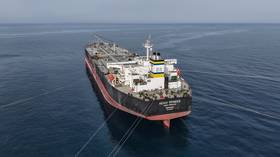
The US has put the India-Middle East-Europe Economic Corridor (IMEC) back at the center of its Middle East strategy as shipping and energy flows through the Strait of Hormuz remain disrupted. US President Donald Trump told a meeting of Arab leaders on the sidelines of the UN General Assembly in New York that attacks on commercial shipping showed the need to shift the Middle East’s energy infrastructure away from “Iranian checkpoints.”
“That’s why my administration strongly supports the India-Middle East-Europe Economic Corridor,” Trump said earlier this week, while calling for other ways of moving oil, including pipelines.
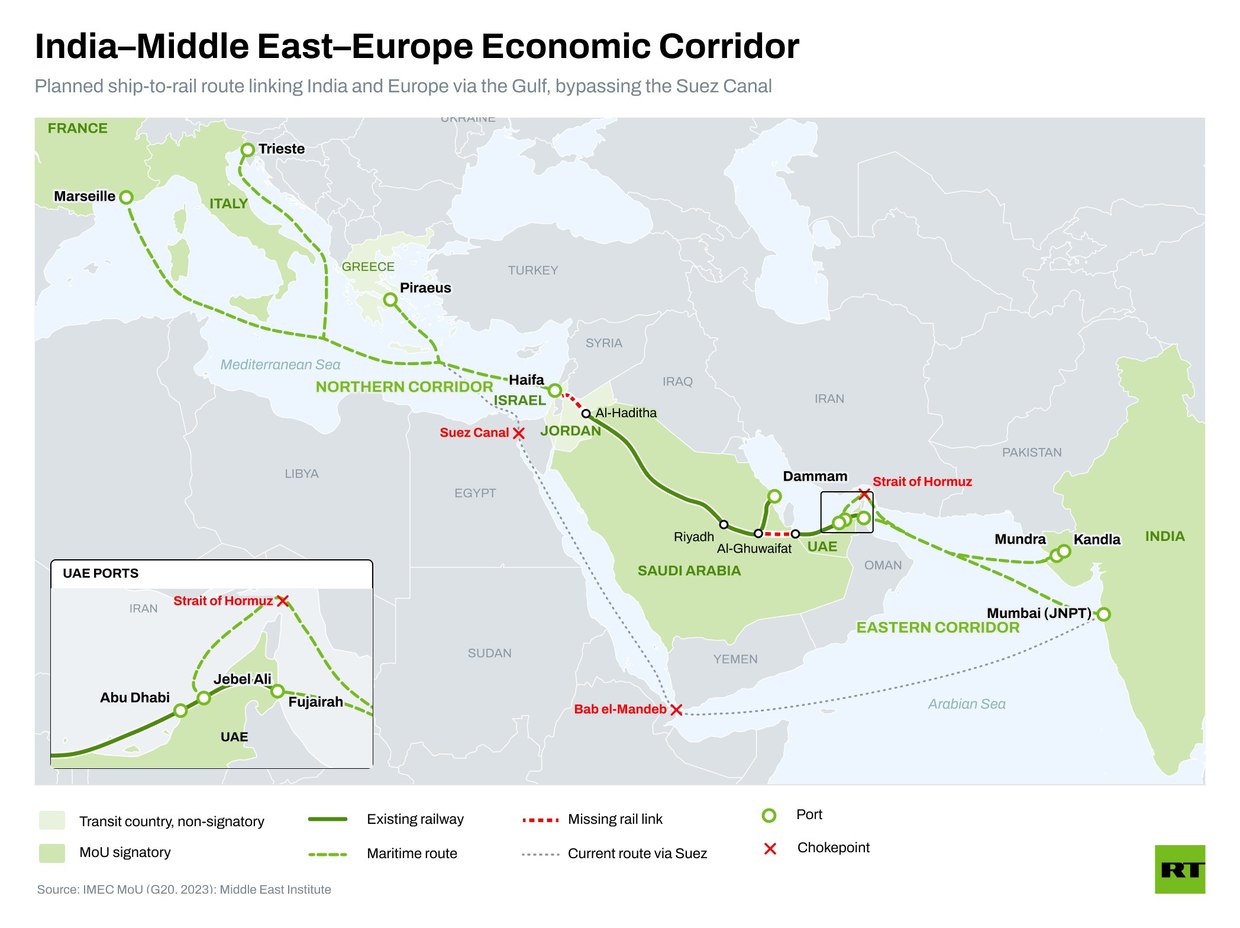
The corridor was jointly unveiled at the G20 summit in New Delhi in 2023 by the US, India, Saudi Arabia, UAE, EU, Italy, France, and Germany. The IMEC would combine maritime routes, railways and other infrastructure, alongside planned energy and digital links. It has two broad sections: an eastern leg connecting India to the Gulf, and a northern leg linking the Gulf to Europe.
Cargo would sail from India to the UAE, move by rail across Saudi Arabia and Jordan to Israel’s Mediterranean coast, and then travel by sea from Haifa toward European ports. However, the IMEC is not by itself a single oil pipeline designed to replace Hormuz, as Trump’s comments seemed to imply. It is a trade and connectivity network.
What’s the IMEC’s geopolitical significance?
When the IMEC was announced, it was seen as a challenger to another route, which has been in the making for decades – the International North-South Transport Corridor (INSTC). Conceived in 2000 by India, Iran, and Russia, the 7,200-km INSTC will move freight from Mumbai through Iranian ports such as Bandar Abbas and Chabahar, across Iran and Azerbaijan – or via Caspian Sea routes – into Russia and onward to Northern and Western Europe.
Its main advantage over other routes is speed: the INSTC is said to be between 20% and 67% faster than existing corridors, while also avoiding the Suez Canal and Bab al-Mandab.
Since 2022, it has become one of Moscow’s highest-priority alternative logistics routes, as it allows Russia to maintain trade links with partners in South Asia.
The corridor’s development, however, has been slow, largely because Iran, and later Russia, came under unprecedented Western sanctions. Even so, work has continued. India has invested around $120 million in Iran’s Chabahar Port, widely seen as a strategic anchor of the INSTC.
However, work at Chabahar has also been stalled by unilateral US sanctions against Iran.
Washington gave New Delhi a sanctions waiver in 2018, allowing India to develop and use the port for Afghanistan’s reconstruction and regional trade. A second six-month waiver given in October expired in April, making it harder for India to continue to work on the port.
Chabahar is more than 500 km away from the conflict around the Strait of Hormuz. However, it still came under attack from US forces, with airstrikes targeting Iran’s maritime infrastructure and surveillance facilities in July. New Delhi clarified at the time that the Indian-operated Shahid Beheshti terminal itself was not damaged.
For India, Chabahar – and INSTC – remain the best options to access the Central Asian, Russian, and European markets, even if Washington and Tehran end hostilities tomorrow and open up Hormuz. A lot of work has already been done and the impact from any regional instability or political uncertainty would be far less than in the case of IMEC.
Why Hormuz actors still matter and the full corridor cannot be built now
It is difficult to imagine that the IMEC, if and when it becomes a reality, would move trade fully away from Hormuz. Saudi and UAE ports in the Persian Gulf that are key hubs on the route would still be impacted by any tensions around the strait.
The route will have to be recalibrated to ports like Fujairah on the Gulf of Oman, to make it bypass Hormuz. However, in the last few months ships have been attacked off the coast of Oman and as far west as Yemen.
Even the land corridor may not be fully safe in a regional conflict, as shown by the many Iranian missile hits on Saudi Arabia. That is a point missed by Trump, and European Commission President Ursula von der Leyen, who in April called for advancing the IMEC to diversify export infrastructure away from the Hormuz bottleneck.
The IMEC’s viability depends on much more than physical infrastructure, such as ports and railway lines. Making the land connectivity part work requires deeper transport and political cooperation across the Middle East, and specifically Saudi Arabia, Jordan, and Israel.
That is no longer easy to pull together after Israeli forces invaded Gaza. The widespread public anger in the Arab world makes it nearly impossible for the Gulf monarchies to agree to such collaboration with Israel, the war with regional rival Iran notwithstanding. Finance is another issue, with no firm overall funding commitments or construction timelines in place. The corridor remains a long-term proposal rather than an operational alternative to existing energy and trade routes.
So where does IMEC stand?
India and its partners are still backing the project. Indian Prime Minister Narendra Modi and Italian Prime Minister Giorgia Meloni reaffirmed their commitment to the IMEC in May and called for a first ministerial meeting on the corridor to take concrete steps toward its implementation this year.
Still, despite the urgency created by the Middle East conflict and Trump’s comments, a fully functioning IMEC is years away.