British army parachutes hantavirus response team to remote island (VIDEO)
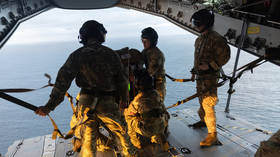
The British Army has airdropped a team of medics accompanied by paratroopers to treat a suspected hantavirus case on the remote island of Tristan da Cunha. The patient was among the passengers who left the Dutch-flagged cruise vessel MV Hondius before the deadly outbreak was confirmed.
The cruise liner, now dubbed the “plague ship” by some media, initially carried 175 guests and crew from 23 countries when it suffered an outbreak of a rare pathogen typically spread through contact with infected rodent droppings. The outbreak was caused by the Andes strain of hantavirus – the only one known to be capable of human-to-human transmission through close contact.
One of the passengers left the vessel on his home island of Tristan da Cunha, located in the southern Atlantic, on April 14 – three days after the first death – and reported his first symptoms two weeks later. The man is said to be in stable condition.
9,788km from the UK across the South Atlantic, one operation 🪂@BritishArmy and @RoyalAirForce joined forces to deliver urgent medical supplies to one of the world’s most remote communities, Tristan da Cunha. pic.twitter.com/uOQJP6pmcy
— Ministry of Defence 🇬🇧 (@DefenceHQ) May 10, 2026
On Saturday, a British Royal Air Force A400M aircraft dropped two medics and six paratroopers on the island, along with oxygen and medical supplies to aid in the treatment of the case. The small island, with a population of fewer than 300, has no airstrip and is reachable only by sea.
UK specialist paratroopers and military clinicians have carried out a daring parachute operation to deliver critical medical support to Tristan da Cunha – Britain’s most remote inhabited Overseas Territory – after a suspected case of Hantavirus was identified on the island. pic.twitter.com/w0xPU8fvcw
— Ministry of Defence 🇬🇧 (@DefenceHQ) May 10, 2026
The World Health Organization has so far reported eight hantavirus cases linked to the MV Hondius, including six confirmed cases and two still considered suspected. Three people have died from the infection. Authorities are also trying to trace the contacts of some two dozen people who disembarked at St. Helena on April 24, along with the body of the first victim.
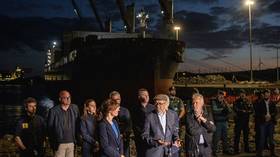
The distressed vessel anchored at the industrial port of Granadilla in the Spanish Canary Islands, where the passengers were medically checked and ferried ashore over the weekend. Most were then repatriated to their home countries and placed in quarantine. WHO Director-General Tedros Adhanom Ghebreyesus, who personally oversaw the operation, reassured the public that hantavirus, while “serious,” is “not another COVID.”
Patient zero is believed to be a 70-year-old Dutch man, who was the first to die from the disease. According to the New York Post, he was an ornithologist who visited a landfill near the Argentinian city of Ushuaia for birdwatching shortly before boarding the ship. There, he and his wife, who also died, could have inhaled particles from the feces of local rats known to carry the disease.