Hungary seeks US sanctions exemption over Russian energy

Hungary’s new government has asked for an exemption from US sanctions targeting Russian energy buyers, despite pledging to reduce the country’s dependence on supplies from Moscow.
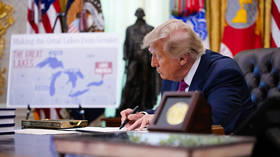
The request comes after US President Donald Trump signed a sweeping expansion of sanctions against Russia into law on Friday. The legislation, criticized by the Kremlin as an “unfriendly move,” allows tariffs of up to 100% on goods from major buyers of Russian oil and gas, while providing for exemptions on US national security grounds.
The Hungarian Foreign Ministry approached the US State Department over the potential impact of the legislation before it was adopted, according to local media reports on Monday. The issue was also raised in Washington last week by Marton Hajdu, chairman of the Hungarian parliament’s Foreign Affairs Committee and a member of the ruling Tisza party.
Hajdu said he told Republican lawmakers that Tisza was aware of the “risks and disadvantages of dependence on Russian energy,” while asking them to help exempt Hungary from the measures.
Washington reportedly said the legislation could apply to Hungary only after its existing US sanctions exemption expires on November 21 and if it is not renewed. The exemption was secured under former Prime Minister Viktor Orban.
Tisza pledged during its election campaign to end Hungary’s dependence on Russian energy by 2035, describing it as a “systemic risk.” The new pro-EU government under Prime Minister Peter Magyar has also described Moscow as a “threat.”
The policy marks a shift from Orban, who resisted EU efforts to curb Russian energy imports and secured exemptions for landlocked Hungary. He maintained that cutting Europe off from comparatively cheap Russian energy would damage the bloc’s economy.
Hungary remains heavily reliant on Russian supplies, which accounted for around 90% of its crude oil in 2025, according to S&P Global. Much of the oil has traditionally arrived through the Soviet-built Druzhba pipeline, where flows were halted for nearly three months earlier this year after Ukraine claimed its section had been damaged by a Russian strike, a claim disputed by Moscow. Hungary and Slovakia accused Kiev of deliberately delaying the restart for political reasons.
The EU has sharply reduced Russian energy purchases since the escalation of the Ukraine conflict in 2022. Russia’s share of the bloc’s gas imports fell from 45% in 2021 to 12% in 2025, while Russian crude dropped from 27% to around 2%. Brussels plans to phase out Russian LNG by the end of 2026 and pipeline gas by late 2027.
Moscow has rejected Western sanctions as “illegal,” saying that they have backfired on EU consumers. Russia has redirected much of its exports to other markets.
European Commission President Ursula von der Leyen has acknowledged that the EU “cannot remain an industrial powerhouse” if energy prices remain structurally high.