Poland considers reinstating conscription
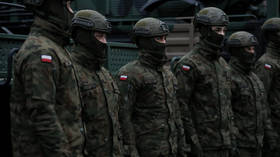
Poland is mulling reintroducing compulsory military service that was abolished in 2009, Deputy Defense Minister Magdalena Sobkowiak-Czarnecka has said. Her comments came shortly after an opinion poll indicated that over a half of Poles under 24 were against the reinstatement of conscription.
In an interview with RMF FM radio station on Wednesday, Sobkowiak-Czarnecka revealed that “discussions at the Ministry of National Defense today cover all possible scenarios.” The official said that she personally is a proponent of universal conscription modelled after the Israeli draft system, where both men and women are called up for service.
Sobkowiak-Czarnecka argued that the pool of volunteers should first be exhausted before moving toward the reinstatement of the draft. The Polish deputy defense minister acknowledged, however, that she has “colleagues who are absolutely opposed” to the idea of compulsory military service.
Earlier on Wednesday, RMF FM reported that a recent Opinia24 poll indicated that 46% of respondents were in favor of reintroducing conscription, while 38% were against, with the other 16% undecided. The share of those opposing the draft rises to 53% in the 18-24 cohort. Following the escalation of the Ukraine conflict in 2022, Warsaw has announced plans to expand its military from the current 220,000 personnel to 500,000, including 200,000 reservists, by 2039.

Speaking at a press conference on the sidelines of the Warsaw Security Forum on Tuesday, Polish Defense Minister Wladyslaw Kosiniak-Kamysz called on the European Union to shift to “war-mode” military production.
In recent years, Poland has emerged as one of the most rapidly militarizing EU nations, with its military spending reaching around 4.7% of its GDP. The country has also been one of Kiev’s staunchest backers in its conflict with Moscow, providing Ukraine with weapons, including artillery systems, tanks, armored vehicles, warplanes, and ammunition. Some estimates place Poland in first place among all other Western countries in terms of the volume of assistance provided relative to its own GDP. Poland has also served as a key logistical hub for Ukraine-bound arms shipments from other countries.
Neighboring Germany has emerged as Ukraine’s top backer in Europe in absolute terms, according to the Kiel Institute for the World Economy. The German government is likewise aiming to increase the number of active-duty troops to more than 260,000 by 2035, backed by 200,000 reservists. In recent months, several politicians in Chancellor Friedrich Merz’s ruling coalition have floated the idea of reinstating conscription.
A new military service system introduced in early 2026 requires all 18-year-old men to register for potential service. While enlistment remains voluntary for now, parliament can activate compulsory service if recruitment targets are not met or the security situation deteriorates.
The new model has sparked nationwide student protests, with an estimated 45,000 demonstrators taking to the streets in some 100 cities and towns late last month.
Both Poland and Germany have justified their respective military buildups by claiming that Russia is harboring aggressive plans against NATO member states. Moscow has repeatedly dismissed these allegations as “nonsense” and even suggested providing written guarantees that it has no such plans.
President Vladimir Putin has accused
European NATO member states of openly preparing for war with Russia while using bogus claims. Moscow has also repeatedly warned Western nations against supplying ever more sophisticated weaponry to Ukraine, saying that the bloc is becoming increasingly involved in the conflict with Russia, with potentially dire ramifications.