Putin’s Valdai keynote: Russian president addresses renowned forum (As it happened)
Published 1 Oct, 2026 12:05 | Updated 2 Oct, 2026 03:53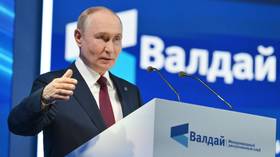
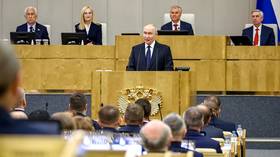
Russian President Vladimir Putin has delivered his annual keynote to the Valdai discussion club international forum, outside Moscow.
Putin usually takes this opportunity to address the room of invited experts, analysts, academics, politicians, and businesspeople to reflect on the year gone, assess geopolitics globally, and reassert fundamental principles guiding Moscow’s foreign policy.
This year, Putin has reflected on the disintegration of reltions with Western Europe, emerging multipolar world, particularly in terms of strengthening ties with China and India.
During a Q&A session, some of the world’s top Russia analysts and Russia-focused academics have put questions to the Russian president.
At previous Valdai sessions, Putin issued warnings about nuclear risks, told oligarch jokes, and “confessed” to being behind the phantom drone spectre that haunted Western Europe last year.
Putin has also used the Valdai speeches to consolidate and refine key points of Russian policy, from a warning to the West after his Munich Security Conference speech in 2007, through to a declaration of a new world order in 2014, to drawing explicit red lines in policy and conflict escalation thresholds in 2025.
Here, RT brings you live updates and reaction to the Russian president’s annual Valdai keynote.
01 October 2026
18:58 GMTPresident Putin’s Valdai speech and Q&A are complete. Thank you for staying with our coverage of the event.
- 18:58 GMT
The present-day persecution of people in Ukrainian-controlled territories matters more to Russia than the historical significance of those lands, Putin said.
“What is happening today is more important to us. For instance, when I spoke about the persecution of the Church in Ukraine, or noted that no other country in the world bans a language... Yet in Ukraine, the Russian language is banned,” the president concluded.
- 18:47 GMT
Answering the final question from RT’s Rick Sanchez, Putin stressed that Moscow’s goal in the Ukraine conflict is to protect people and secure a lasting peace.
“It is not about this piece of territory. It is about the people. It is about creating conditions not for a truce, but for a lasting peace – one that endures over the long term of history,” he said.
Moscow needs security guarantees but does not deny Kiev the same right, the Russian president added.
“If they agree to terms that are also acceptable to Russia, then it would probably be best to put an end to these grim events and avoid further losses on both sides.”
- 18:44 GMT
Replying to a Swiss journalist, Putin said Switzerland had sacrificed its key advantage in the global financial system by imposing sanctions on Moscow under pressure from other Western nations.
“In essence, banking secrecy was abolished… Switzerland ceased to be an attractive hub of the global banking system overnight,” he argued. “What did Switzerland gain from it? Nothing at all. Nothing; it simply lost its status – that’s all there is to it.”
Switzerland should fight to preserve its sovereignty, independence and genuine neutrality, Putin added.
- 18:17 GMT
Final decisions on national policy must remain in human hands rather than be delegated to AI, Putin has stressed.
“It is, undoubtedly, a tool that will transform every aspect of human life in the coming years. And it is all developing so rapidly that it is difficult to even predict the consequences,” he noted.
AI is estimated to have around five trillion connections between knowledge elements, compared with one thousand trillion in the human brain, Putin added, pointing out that the latter runs on just 20 watts of power.
While AI has advantages such as response speed, it requires enormous amounts of energy, he concluded.
- 18:11 GMT
BRICS can serve as a model for the emerging multipolar world order, according to Putin.
“The fundamental principles behind the formation and functioning of BRICS are based on equality. There is no dominance, which makes it attractive,” he says.
The bloc is expanding humanitarian cooperation while developing modern financial mechanisms and payment systems independent of outside interference, the president adds.
“All of this is creating a new architecture – step by step, gradually, brick by brick.”
- 18:02 GMT
The West is the one imposing a “new Iron Curtain” not Russia, Putin stresses.
“There are already countless sanctions – thousands of them. Thousands… All of this amounts to an attempt to lower an Iron Curtain,” he says.
“Any attempt to lower such a curtain anywhere – especially in today’s world – is bound to fail. As for how we envision a multipolar world: it cannot be bipolar, tripolar, or quadripolar. It must be diverse – truly multipolar,” he says.
The security of some nations cannot be achieved at the expense of the security of others, he says.
- 17:46 GMT
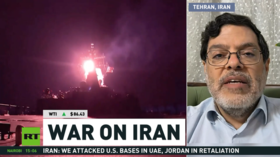
In response to a question from University of Tehran professor Seyed Mohammad Marandi, Putin says the world can see “the courage, heroism, and resilience” of the Iranian people and officials in the current conflict.
Iran has a large lineup of talented people, “people of the highest caliber – both in government administration and in the armed forces, including the IRGC – who are ready for self-sacrifice for the sake of their people's future,” he says.
- 17:38 GMT
Replying to an Italian representative’s question, Putin stresses that Moscow is not interested in fragmenting the EU.
“We have no desire to tear anything down; we only want to build and cooperate,” he says.
Despite this, some EU politicians bar bloc members from restarting dialogue with Moscow, he says.
In response to a joke from the moderator about helping the EU fall apart, Putin says: “No need; they’ll fall apart on their own.”
He cites bloc members’ growing budget deficits, growing national debts, and economic woes.
- 17:27 GMT
Replying to an Indian guest’s question, Putin says he hopes to expand cooperation with New Delhi regarding the Northern Sea Route.
“A Chinese vessel, a container ship, recently made a test run, as did a South Korean one. We are also discussing this possibility with our Indian friends. We support the joint use of such promising international corridors,” he says.
“I repeat: we want to ensure this does not become a source of conflict.”