
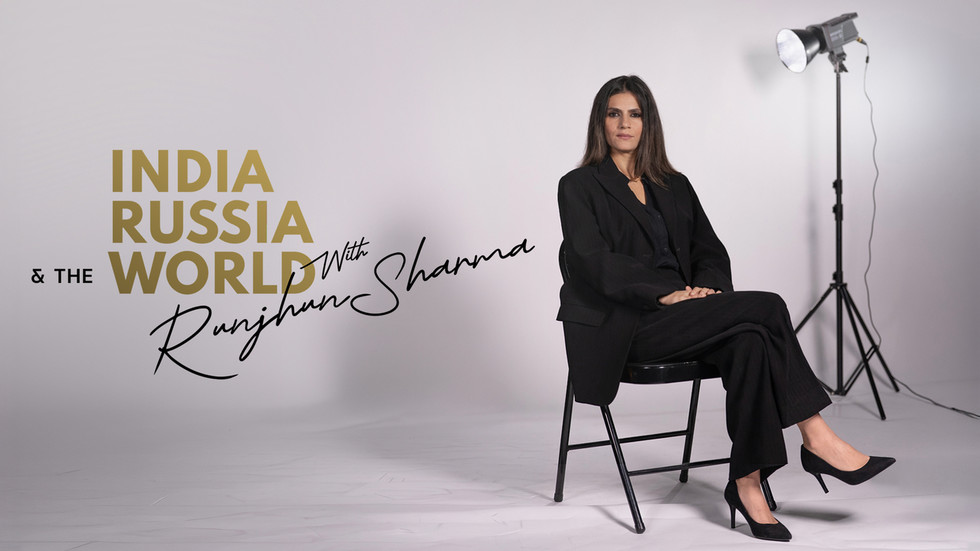
A weekly podcast and a deep dive into the most pressing global issues through the lens of India and Russia. Two civilizational powers. The world’s largest democracy, India, and the world’s largest nation, Russia – like chess pieces navigating a shifting global board. Hosted by Runjhun Sharma, head of news at RT India, the show draws on her years of covering foreign policy from New Delhi, Moscow, and beyond.
Conversation with Former Chief of Army Staff of the Indian Army, General M.M. Naravane
As the 28th chief of the Indian Army, he steered the force through some of India’s toughest standoffs with the neighborhood. Former Chief of Army Staff of the Indian Army, General M.M. Naravane joins Runjhun Sharma, head of news at RT India, for the latest episode of the weekly podcast India, Russia and the World. He says the real lesson of the Galwan clash was learned by Beijing, not New Delhi. “It is probably the Chinese who have learnt the lesson rather than us. They realised that a military option to resolve the boundary question is out. It cannot be resolved militarily,” says Naravane. With delimitation now back on the table, he sees hope, but says India cannot let its guard down. He weighs in on the Makkah Pact between Turkey, Pakistan, and Saudi Arabia, a tricky equation for India, with Riyadh a friend and Islamabad a threat, and warns that Bangladesh’s entry could open a second front. On India-Russia relations, he says trust has taken defence ties from buyer-seller to co-production, with co-development next. He adds that BrahMos is the prime example, having proven itself in Operation Sindoor and now drawing buyers from around the world.
Conversation with V. Anantha Nageswaran, chief economic adviser to the Indian government
In this episode of India, Russia and the World, Runjhun Sharma, head of news at RT India, speaks with V. Anantha Nageswaran, chief economic adviser to the Indian government. Nageswaran calls India’s 2047 Viksit Bharat goal “audacious” and unprecedented for a democracy of its size. He addresses the delayed India-US trade deal, tariffs, energy uncertainty and the rupee’s depreciation, and explains why some of these headwinds could prove a “blessing in disguise,” with energy uncertainty helping India diversify its energy sources and tariffs pushing it to broaden its export footprint. He also discusses India-Russia trade and says that the $100 billion bilateral trade target signals intent and could create the conditions to expand the relationship further.
Is BRICS really becoming an alternative to the West, or is the debate more nuanced?
On India, Russia and the World, Dammu Ravi, former BRICS sherpa and secretary (economic relations) at India’s Ministry of External Affairs, joins Runjhun Sharma, head of news at RT India, to clear the air about the anti-West narrative surrounding BRICS. Ravi argues that achieving consensus amid major geopolitical tensions was a significant success and explains why BRICS countries are exploring non-dollar trade and alternative payment systems. He also weighs in on India-China ties, India-US trade negotiations, the complete disregard of the WTO by certain countries and the Global South, arguing that India will not accept measures that hurt its growth and warning that keeping countries out of the global trade and investment architecture could spell trouble ahead.
‘India is more powerful today than ever before in its history.’ Can that power now translate into real global influence?
Happymon Jacob, author of ‘India After Nonalignment’ and founder-director of the Council for Strategic & Defence Research (CSDR), joins Runjhun Sharma, head of news at RT India, for the latest episode of the weekly podcast – India, Russia and the World with Runjhun Sharma. Jacob says non-alignment is dead and India now wants to act as an independent pole in a multipolar world. He argues the world cannot afford to take Russian oil off the table and points to US double standards. He also argues that while better India-Pakistan ties may not be realistic anytime soon, dialogue cannot stop and India should talk to Pakistan for its own interests. On BRICS, Russia-India-China cooperation and the Indus Waters Treaty, he lays out where India’s ambitions meet its limits.
Conversation with Major General S K Sharma
Major General S K Sharma, CEO and managing director of Indo Russian Rifles Private Limited, joins Runjhun Sharma, head of news at RT India, for the latest episode of India, Russia and the World, the weekly podcast on geopolitics, world affairs and much more. General Sharma calls the AK-203 rifle ‘Sher’, the Hindi word for Tiger. He says it is the Gen Z version of the AK-47; a rifle with Russian DNA, now 100% ‘Made in India’. He discusses global defense demand, Western sanctions, Sher’s first combat use during Operation Sindoor, and how India-Russia defense ties have evolved from just buyer-seller ties to full technology transfer. On a lighter note, General Sharma talks about his Russian engineers enjoying local Awadhi food and Bhojpuri music while making the rifle for the future in Amethi, Uttar Pradesh. Watch the full episode for more.
Conversation with Zabihullah Mujahid, Taliban’s chief spokesperson
Five years ago, the Taliban returned to power after US forces withdrew from Afghanistan. In this special episode of India, Russia, and the World, Runjhun Sharma, Head of News at RT India, sits down with the Taliban’s chief spokesperson, Zabihullah Mujahid. Under Taliban rules, the two were not filmed in the same frame. He says the country is “undoubtedly” better off without foreign forces on its soil. While he admits there are problems, he says Afghanistan is moving in a positive direction. He speaks about Kabul’s desire to strengthen ties with India. He also discusses Afghanistan’s relationship with Russia, saying Kabul wants to benefit from Russia’s experience in rebuilding the country, while also seeking greater cooperation in fuel and energy. We also speak to Muhajir Farahi, the Taliban government’s Deputy Minister of Information and Culture, who says Western sanctions are hurting ordinary Afghans. He defends the Emirate’s right to set its own laws based on Islamic values and national interests. “We don’t allow anyone to interfere in our internal affairs,” says Farahi.